How to Start a Business With No Money: What Top Founders Actually Did
July 14, 2026 | 8 min read
The version of entrepreneurship that gets celebrated online — the Series A announcement, the Forbes cover, the TED talk about disruption — is almost always the ending of a story whose beginning nobody talks about.
The beginning is messier. It involves betting on something nobody else believes in yet, raising money in markets that do not want to give it, moving to cities where you know nobody, and building something real before you have the resources to do it the right way.
The founders who have actually done it share a different playbook than the one being sold to aspiring entrepreneurs. And across conversations on The Disruptors, a consistent picture emerges of what bootstrapping a business actually looks like when it is not being glamorized.
The Hardest VC Market in 30 Years — And Why That Is Actually the Point
Before talking about how to start a business with no money, it helps to understand the environment founders are navigating right now.
Ari Zilka built his career solving the hardest scaling problems in enterprise technology — from Walmart.com in the early 2000s to building companies that made real-time data the foundation of business decisions. When he started My Decisive AI, he was not a first-time founder chasing a trend. He had decades of operational experience and a proven track record. He still found fundraising brutally difficult.
“It’s the tightest it’s been in the last 30 years. Venture capitalists will write checks for AI companies if the story is interesting and compelling. If you’re traditional, and we’re a hybrid company, you’re really struggling.”
The reason matters. VCs are not just evaluating ideas — they are evaluating friction. Anything that requires education, behavior change, or patient capital gets flagged as risk. And most genuinely transformative businesses require all three.
“You got to do the bread and butter. You got to do the hard work. You got to do the heavy lifting. And VCs see that as friction.”
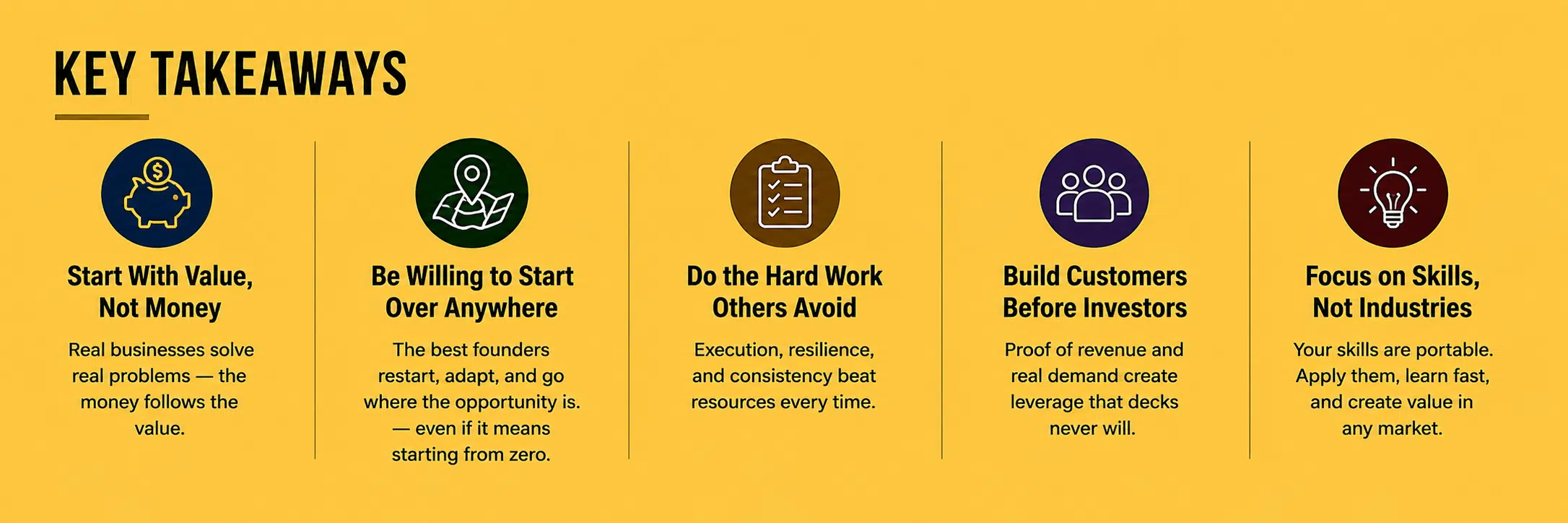
The founders who get through it do not do so by making the pitch easier. They do so by making the proof undeniable — by building revenue, finding customers, and demonstrating that the market exists before they ask anyone else to believe in it.
How to Start a Business With No Money: The Real Framework
The phrase “start a business with no money” is almost always interpreted as a question about tactics: what is the cheapest way to get started? But the founders on The Disruptors frame it differently. For them, starting with no money was not a constraint to route around. It was the discipline that made the business real.
Paul Brightenbach co-founded Priceline — at one point among the top-performing stocks in NASDAQ history — and has spent decades since building companies that apply AI to genuine operational problems. Long before any of that, he had the paper route.
“Our value add was: you can have the paper delivered anywhere you want. Mailbox, front seat of the car, screen door. We charged a minimum $3 tip a week, and we had the largest paper route in town.”
One customer asked him to bring the paper directly into the house and hand it to their elderly, housebound mother. He did it every day. When he left for college, the family sent him $5,000 with a note: You enabled our mother to live in this house another five years.
The lesson he carries from that story into every company he builds is the same: the money follows the value. Not the pitch. Not the deck. The value.
“We have to train the next generation to be value add. What is your added value to the discussion? Whatever it is — that’s step one.”
Marty Romances: Bootstrapping Across Three Countries, Starting From Zero Each Time
Marty Romances built Territory Studio — a design company that has worked on Iron Man, Dune, Blade Runner, Guardians of the Galaxy, and NASA — by doing something most founders are afraid to do even once. He did it three times: he left everything behind and started over in a new country with a new market.
He started in Barcelona. Moved to London to reach bigger clients. Then flew alone to San Francisco to open Territory’s second office and crack the American market — leaving behind his team, his network, and the credibility he had spent years building.
“I left my friends, I left everything. I was there to diversify the business. I’m going to start again. It’s like going back to square one. And what it showed me is that the best return on that investment is the learnings I took from it.”
That willingness to restart — repeatedly, voluntarily, with no guarantee of the outcome — is what distinguishes the founders who build durable companies from the ones who build comfortable ones. His framework for what makes it possible is simple:
“Marry your skills, not the industry. What you do can be applicable to many different industries. Get out of your comfort zone.”
Territory is now a group of companies with over 200 people and five offices. None of it would exist if Romances had stayed in Barcelona because it was working. The insight for anyone thinking about how to start a business with no money: the resource you are actually managing is not capital. It is conviction.

Justin Sherlock: Raising a Seed Round Before the Product Existed
Justin Sherlock founded Caspian — an AI platform that helps companies reclaim tens of billions in unclaimed trade duty refunds — at 33 years old, with no product, no team beyond the two co-founders, and no customers. He raised a full seed round anyway.
“We raised our seed round before we had any product or team. I wanted to build the right product without the pressure to commercialize it immediately, and I needed to be able to hire experienced customs experts as well as experienced software engineers.”
What made that possible was not the pitch deck. It was five years of working inside the exact problem he was trying to solve — at Flexport, funding the supply chains of hundreds of brands and manufacturers, watching tariffs erode their margins, and noticing that almost nobody was claiming the refunds they were legally owed.
“Don’t worry about pigeon-holing yourself. Go dive into a space and learn, and then you’ll develop the idea very organically — versus trying to research a market and talk to hundreds of people.”
The fundraising principle he extracted from the experience applies whether you are raising from VCs or trying to convince your first customer:
“Time to value is so much more important than the absolute value. We’re talking about found money. Why spend 20 hours when you can spend 15 minutes?”
The VC Alternative: Why the Bootstrapping Mindset Wins Either Way
Ari Zilka’s observation about the current VC environment is not just a complaint about fundraising conditions. It is a description of a structural advantage that bootstrapped founders have over funded ones.
When you raise too early, you optimize for the pitch instead of the product. You hire for headcount because you have money to spend, not because you have revenue to support. You build for the deck, not for the customer.
The customer-first, revenue-first discipline that comes from starting with no money is also what produces the most resilient businesses. The companies that survive downturns, failed fundraising rounds, and market shifts are almost always the ones that were forced to be customer-obsessed from the beginning because they had no other choice.
The founders who eventually raise significant capital are almost always the ones who built something real first. The money follows the proof. It always has.
What the 1% Actually Does Differently When Starting With Nothing
The pattern across every founder who started with no money and built something real is not a secret tactic or a funding hack. It is a specific sequence of decisions that looks almost boring when you describe it plainly.
They picked a specific problem they understood better than anyone else. Not a broad market, not a trending sector — a specific, felt pain they had personally experienced from the inside.
They built proof before they built a story. Revenue. Customers. Working product. Something that could not be argued with.
They moved toward difficulty, not away from it. New city. Harder market. More demanding customer. Every time they could have stayed comfortable, they chose the harder path instead.
They stayed long enough for compounding to work. Marty Romances spent sixteen years building Territory. Paul Brightenbach’s paper route lessons took decades to fully express themselves. Ari Zilka spent twenty years in enterprise technology before founding My Decisive AI.
None of these are shortcuts. But they are the actual answer to the question of how to start a business with no money: start where you know something, prove it early, and stay.
FAQ
The founders on The Disruptors consistently describe the same sequence: identify a specific problem you understand from the inside better than anyone else, build the minimum proof that the problem is real and your solution works, and let that proof attract resources rather than trying to attract resources before the proof exists. The capital follows the conviction — but only after the conviction has produced something real.
Bootstrapping means funding the early stages of a business entirely from your own resources or from early customer revenue, without outside investment. For the founders on The Disruptors, bootstrapping was not primarily a financial strategy — it was a discipline that forced them to build something customers actually valued rather than something investors found interesting.
Ari Zilka, who built My Decisive AI in what he describes as the tightest venture capital market in 30 years, describes the answer plainly: you do the hard work first. Revenue, customers, and proof of demand are not just outcomes — they are the fundraising strategy. VCs who will not write a check on a pitch will write one on traction.
Every founder in this article started with significantly less than they eventually needed. What they had instead was specific knowledge — deep, operational, inside-out understanding of the problem they were solving. Justin Sherlock became a licensed customs broker before founding Caspian. Marty Romances spent years doing every type of design job before Territory existed. The knowledge is the capital. Everything else comes later.
IN THIS ARTICLE
1. The Hardest VC Market in 30 Years
2. How to Start a Business With No Money
3. Marty Romances: Three Countries, Zero Safety Net
4. Justin Sherlock: Seed Round Before the Product
5. Why the Bootstrapping Mindset Wins Either Way
6. What the 1% Does Differently Starting From Nothing
7. FAQ
SHARE THIS ARTICLE