AI Hardware News: What Chip Founders Actually See That the Headlines Miss
July 14, 2026 | 8 min read
Every week brings another headline about Nvidia’s earnings, another data center announcement, another trillion-dollar valuation. The AI chip boom is one of the most covered stories in business media.
And yet the people actually building the chips, the infrastructure, and the decision systems that run on top of them describe a reality that looks almost nothing like what gets covered.
The headlines focus on who is winning. The founders on The Disruptors are focused on something more specific: what the next phase of AI actually demands from hardware, from data, and from the companies trying to use it — and why most businesses are still fundamentally missing the point.
The Shift Nobody Covered: From Training to Inference
For the first several years of the AI boom, almost all the money — and almost all the coverage — went to training. Building the models. Feeding them data. Teaching them to understand language, images, code, and reasoning.
That era is not over. But it is no longer where the growth is going.
Mateesh Agarwal, CEO of Positron AI, which builds custom silicon specifically optimized for AI inference workloads, described the shift precisely on The Disruptors:
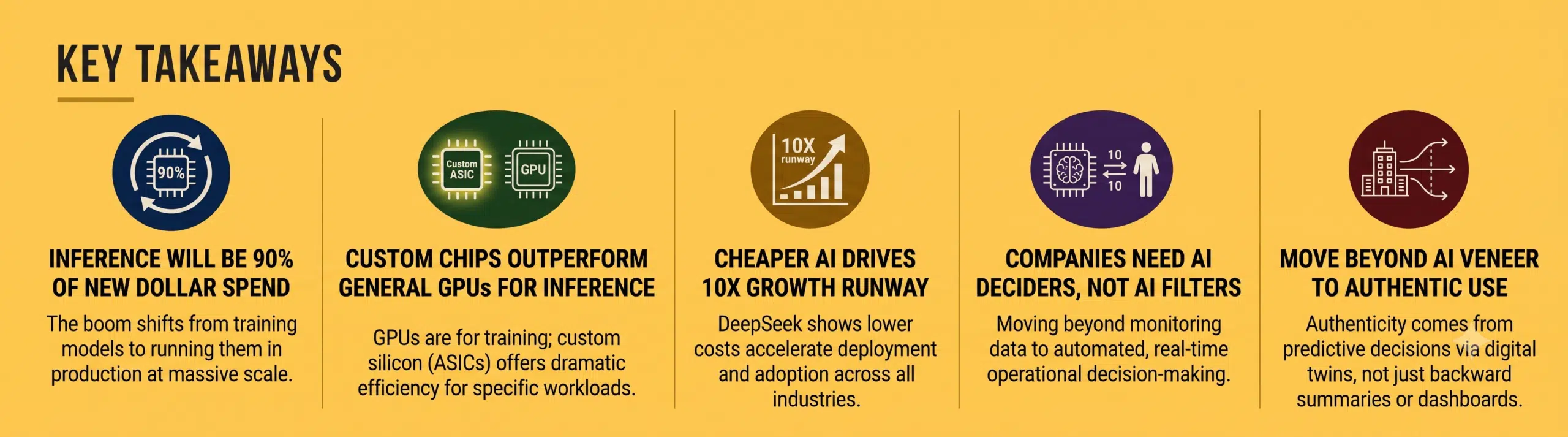
“Inference was the unsexy side of AI, right? Now it is the sexy side. Of the new dollar spend projected in the next six to nine months, inference will be 90% of that spend.”
This is not a subtle shift. It is a near-total reorientation of where the AI infrastructure buildout is heading.
Training is what happens when a company teaches a model. Inference is what happens every time that model is actually used — every ChatGPT query, every AI-generated email, every autonomous agent making a decision. The more AI gets deployed into real products and real workflows, the more inference spend dominates.
And inference has a very different set of requirements than training.
Why Nvidia's Dominance Creates an Opening
The Nvidia story is one of the most remarkable in the history of technology. A company that built its business on gaming graphics cards found itself at the center of the most important infrastructure buildout of the decade, and executed on that positioning with almost flawless precision.
But the characteristics that make Nvidia’s GPUs exceptional for training create a specific inefficiency for inference — and that inefficiency is where a new generation of chip companies is finding its opening.
“Nvidia is probably the smartest company on planet Earth. They’re definitely the most valuable company on planet Earth. These GPUs are phenomenal pieces of technological marvel — but they were really built for training.”
GPUs are general-purpose by design. They are built to run 100 different applications across 100 different use cases. That flexibility is valuable when you are training a model. It becomes less valuable when you are running a specific inference workload at massive scale.
“When you’re designing custom silicon, you are saying we’re going to focus on this type of application and really make sure that all of the silicon — all the transistors, all the memory, all the computing — is focused towards running that very efficiently.”
Positron’s approach is to build chips that do not try to compete with Nvidia across the board, but instead find the specific slice of the inference market where a purpose-built chip dramatically outperforms a general-purpose one.
The DeepSeek Moment: What It Actually Meant
Few events in recent AI history created more confusion — or more market volatility — than the release of DeepSeek in early 2025. Nvidia lost hundreds of billions in market cap in a single day. Analysts questioned whether the infrastructure buildout was justified.
The founders building inside the AI stack read it very differently.
“By making it cheaper, you make it more accessible. This is the fundamental theory behind Positron — you make intelligence cheaper such that more of it is deployed, more of it is used, and then you drive more adoption of it.”
DeepSeek was not evidence that less infrastructure would be needed. It was evidence that the demand curve for inference would expand faster than anyone had modeled — because when the cost of running AI drops, the number of use cases that become economically viable explodes.
“AI has reached roughly 500 million people in two and a half years. The internet took until 2002 to reach 500 million people. AI has at least a 10x growth runway from here, and it’s accelerating at 3 to 4 times the pace the internet grew.”
The market reaction to DeepSeek was a short-term air pocket in a long-term demand curve. The founders who understand what inference actually is were not surprised.

The Problem Beneath the Infrastructure: Flying Blind on Data
Building faster, cheaper chips is only half the equation. The other half — the half that almost no one in the AI news cycle covers — is what happens to the data those chips process once it arrives.
Ari Zilka spent twenty years at the intersection of enterprise technology and real-time data, including early work at Walmart.com, before founding My Decisive AI. His company sits at a layer of the AI stack that most people do not even know exists: the layer between monitoring data and actual decisions.
“Humans look at monitoring data and make one to ten decisions a day. My Decisive looks at monitoring data and makes a thousand to ten thousand decisions for a business in a day.”
Most companies have built elaborate systems to collect data about how their applications, infrastructure, and operations are performing. They have dashboards, alerts, monitoring platforms. They pay millions of dollars a year for observability tools. And then a human sits down, looks at all of it, and decides what to do next.
“You don’t need a filter. You need a decider. You need a framework that says you’re supposed to make this bigger, not smaller. That’s what AI should be doing. And it’s too much data for humans.”
The gap between what AI could do and what most enterprises are actually doing with it is enormous. The infrastructure buildout — the data centers, the chips, the models — is the visible part of the iceberg. The invisible part is the organizational and operational layer where most of the value is either captured or lost.
The Veneer of AI: Why Most Companies Are Not Actually Using It
Vice Admiral Trey Whitworth, who spent 36 years in national security and intelligence before joining R4 Technologies, introduced a concept on The Disruptors that cuts through almost every piece of AI coverage being written right now. He called it the veneer of understanding.
“You can have a piece of furniture that the veneer looks great, but if it’s out of particle board and it gets wet, it’s no good anymore. The question is: how do you make it authentic through and through?”
Paul Brightenbach, co-founder of Priceline and CEO of R4 Technologies, built the company around exactly this problem. Most AI deployments give companies the appearance of intelligence without the substance. They aggregate data. They generate dashboards. They summarize what happened.
“Everyone knows ChatGPT and LLMs. Imagine having perfect information about what to do tomorrow, what to do next week. That’s what we built R4 to do.”
R4’s platform builds a real-time, cross-silo model of how the business actually operates and then uses that model to make predictive decisions rather than just report on past events. The distinction matters because most of the value in AI is not in knowing what happened. It is in knowing what to do next. And most of the AI being deployed in enterprises right now is still, fundamentally, a better way of looking backward.
What the AI Hardware Boom Actually Means for Leaders and Investors
The AI chip story is not just a story about Nvidia, or about which ASIC startup will be next. It is a story about a fundamental reorganization of where computing value lives.
For the past decade, value in technology concentrated at the application layer — the software companies that used cheap cloud computing to build products at scale. The infrastructure was commoditized. That is reversing.
“If you think about the three pillars of AI — energy infrastructure, AI models and data, and silicon and networking — it’s the silicon companies that have captured the most value. That’s where we’re trying to play.”
The next phase of that story is inference at scale, decisions in real time, and the gap between companies that are genuinely using AI to change how they operate and companies that have a veneer of AI that looks convincing from the outside.
The founders building in that space know exactly which category most enterprises fall into. And they are building the infrastructure to close that gap.
FAQ
Training is the process of teaching an AI model — feeding it data until it learns patterns. Inference is what happens every time that model is actually used to answer a question, generate content, or make a decision. As AI moves from research into real products and workflows, inference becomes the dominant workload and the dominant cost. Mateesh Agarwal of Positron AI estimates that inference will represent 90% of new AI infrastructure spending within the next year.
Yes, and the approach is not to compete across the board — it is to build purpose-specific chips optimized for inference rather than training. Companies like Positron AI build custom silicon that performs significantly better than general-purpose GPUs for specific inference workloads, at lower cost and lower power consumption. Nvidia’s GPUs are general-purpose by design; custom chips can outperform them for specific applications by dedicating all available silicon to that one task.
DeepSeek demonstrated that it was possible to train a highly capable AI model at dramatically lower cost than previously assumed. The market interpreted this as bearish for infrastructure spending. The founders building inside the AI stack interpreted it the opposite way: lower costs mean more use cases become economically viable, which drives more inference demand, which requires more infrastructure. Making AI cheaper accelerates adoption, not replaces it.
Most enterprise AI today is still monitoring — collecting data, generating dashboards, alerting humans to problems. Ari Zilka of My Decisive AI describes the gap plainly: humans make one to ten decisions a day using monitoring data; an AI system can make thousands. The companies that have moved from monitoring to real-time AI decision-making have a structural advantage over those still relying on humans to interpret data and decide what to do next.
IN THIS ARTICLE
1. The Shift Nobody Covered: Training to Inference
2. Why Nvidia’s Dominance Creates an Opening
3. The DeepSeek Moment: What It Actually Meant
4. Flying Blind on Data
5. The Veneer of AI
6. What the Hardware Boom Means for Leaders
7. FAQ
SHARE THIS ARTICLE