
How the 1% Thinks About Family Business Succession and Generational Wealth
July 7, 2026 | 8 min read
There is a moment in every family business when the founder realizes the company outlived the plan. The business worked. The growth happened. And now someone has to decide what comes next — who runs it, who owns it, and whether the next generation actually wants it.
How that moment gets handled separates the dynasties from the businesses that quietly disappear when the founder does.
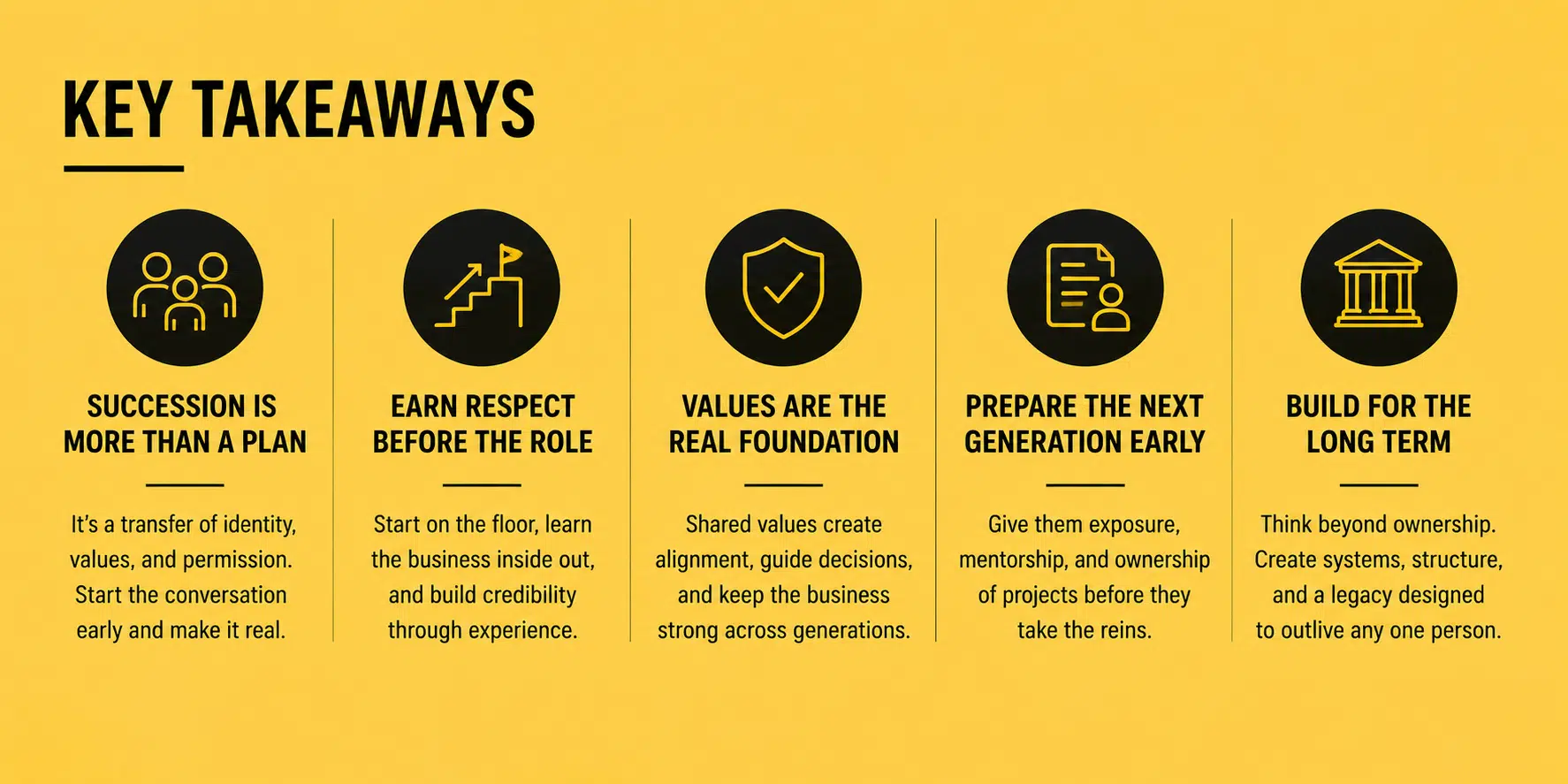
Across conversations on The Disruptors, the people who have built and passed on family businesses share a pattern that most succession planning guides miss: the transfer of a family business to the next generation is never just a financial transaction. It is a transfer of identity, values, and permission.
Why Most Family Business Succession Plans Fail Before They Start
The statistics on transferring a family business to the next generation are not encouraging. Research consistently shows that only about a third of family businesses survive the transition to the second generation — and far fewer make it to the third.
The conventional explanation is financial: lack of estate planning, unclear ownership structures, tax exposure. But the founders who have actually done it successfully point to something simpler. Most succession plans fail because the business was never really separated from the person who built it.
Lawrence Calcano, CEO of iCapital — which now manages or reports on $1.4 trillion in assets — spent 17 years at Goldman Sachs watching wealth transfer up close before building his own generational company. His advice to the next generation is almost aggressively simple:
“The world owes you nothing. Everything you do in the world, you’ve got to earn. And you’ve got to work hard and you’ve got to be flexible.”
That philosophy shapes how the one percent actually thinks about generational wealth. The goal is not to hand the next generation a finished product. It is to give them the conditions — the values, the training, the earned respect of the people around them — to build something themselves.
The Floor-First Approach: How Lisa Corbasero Inherited High-Tech Honeycomb
Lisa Corbasero is the CEO of High-Tech Honeycomb, a 36-year-old aerospace manufacturing company that makes one of the most critical components in commercial jet engines. Her father — a Brazilian immigrant who arrived in the United States as a lobster fisherman with a fourth-grade education — built the company from scratch, literally starting with a machine he built in the garage.
When Lisa joined the company in her mid-twenties, her father did not give her a title or an office. He gave her a welding torch.
“He said, ‘Lisa, go answer the phones. Lisa, go pack parts. Lisa, go do some hand welding. Lisa, go visit a customer.’ And I’m telling you, every month it seemed like he was trying to fire me.”
Looking back, she understands what he was actually doing: building the credibility that no org chart can manufacture. When you have welded the parts, packed the boxes, and answered the phones, the employees who have done those things for 30 years see you differently. Not as the owner’s daughter. As someone who understands the work.
That floor-first philosophy now shapes how she is bringing her own sons into the business. Her older son started by supervising on the shop floor. Her younger son began by inspecting and expediting parts.
“I wanted him to do what my father did and earn the respect of the employees. And I’m proud to say he’s out there and he’s doing a great job.”
The insight that transfers to any family business is this: succession planning is not a document you file with an attorney. It is a decade of deliberate preparation that starts on the floor, not in the boardroom.
Building a Family Brand: The Wahlberg Model
Mark Wahlberg built Wahlburgers with his brother Paul for a different reason than most people assume. It was not a vanity project. It was a deliberate bet on the power of family as a business asset — and a lesson learned from the restaurant industry about what actually scales.
Paul Wahlberg is a trained chef who spent years making other restaurants successful. Mark saw an opportunity to redirect that talent into something the family could own together.
“My brother was always a culinary star and he was working for other people and making the restaurant successful. And I started having success and he was like, you know, I’d love to open my own restaurant. I said, well, I’d love to finance it for you and support you.”
The brand name, though, was a harder sell.
“He said, ‘I want to call it Wahlberg.’ I said, ‘Not a chance. I just spent 20 years trying to go from Marky Mark the underwear model to being a credible actor and producer, and now we’re going to do Wahlburgers?’ I said, ‘You’re crazy.'”
Then the entrepreneur in him overrode the instinct. What Wahlberg understood is what the one percent consistently understands about family business: the name is not a liability. It is a distribution advantage. When the brand authentically represents something real — a family, a craft, a standard of quality — it travels differently than a manufactured business name.
The lesson from the contraction is equally instructive. Wahlburgers has operated up to 100 locations, and the pullback was deliberate:
“Now for us, it’s not about the amount of locations. It’s about having the right locations.”
That discipline — choosing depth over reach — is exactly how family businesses preserve the thing that made them worth building in the first place.

The Great Wealth Transfer: Why Only 13% of Heirs Keep the Same Advisors
The scale of what is about to happen to family wealth in the next two decades is genuinely hard to comprehend. Tara Giuliano, Chief Marketing Officer of Nuveen — one of the world’s largest asset managers with over $1 trillion under management — has spent years thinking about who inherits what next.
The statistic she returns to is one that keeps the advisory industry up at night:
“Only 13 or 14% of assets that transfer to the next generation are going to use the old advisors.”
The rest leave. They find someone who speaks their language, shares their values, and communicates the way they consume information. This has direct implications for how family businesses should think about transferring a family business to the next generation. The next generation of owners is not passive. They will restructure what they inherit around their own values — which means the founders who shape those values deliberately, through work and conversation and shared experience, will find their businesses survive. The ones who defer the conversation until it is forced by illness or death will not.
How to Build Generational Wealth Through a Family Business: The Three Principles
The founders on The Disruptors who have successfully transferred a family business to the next generation converge on three principles that rarely appear in formal succession planning guides.
1. Earn the floor before you lead the floor. Lisa Corbasero’s father gave her every job in the company before he gave her a title. Mark Wahlberg financed his brother’s restaurant because Paul had already proven himself in other people’s kitchens. The one percent does not hand the keys to someone who has not already driven the car.
2. Keep the conversation early and continuous. Lawrence Calcano sends a company-wide email every single weekend — for twelve consecutive years. The point is not the email. The point is that the people around him never have to guess what he values or where the company is going. The same principle applies to family businesses: the succession conversation should start years before it becomes urgent, and it should never really stop.
3. Separate the business from the person, but honor the values. The highest-risk moment in any family business succession is when the founder’s identity and the company’s identity are indistinguishable. Lisa Corbasero’s father built a culture so specific and so clear — precision, cleanliness, respect for the people doing the work — that it survived him. That is the actual legacy. Not the ownership stake. The standards.
What "Generational Wealth" Actually Means to the 1%
The phrase “generational wealth” gets used almost exclusively in financial terms — assets, ownership stakes, real estate. The one percent thinks about it differently.
Tara Giuliano grew up without money, the first person in her family to attend college. She was able to buy her parents a house. That reversal — the child funding the parents’ stability — is one of the most common origin stories on The Disruptors.
What those founders built was not just financial capital. They built operational knowledge that compounds across generations. The floor-first training Lisa Corbasero received from her father made her a better CEO than any MBA program could have. The values Lawrence Calcano absorbed at Goldman — client centricity, teamwork — became the backbone of iCapital.
Generational wealth, for the one percent, is not primarily a balance sheet. It is a set of standards and a culture of accountability that survives the people who created it.
That is the harder transfer. And it is the only one that actually matters.
FAQ
The founders who do it successfully share a common approach: the next generation earns credibility on the floor before being handed authority. This means years of deliberate preparation — working every role in the business, building genuine relationships with employees, and understanding the craft at the operational level before leading it. The legal and financial structures matter, but they are secondary to the human preparation.
Roughly one-third of family businesses survive the transition to the second generation. The primary reason they do not is not financial — it is the failure to separate the business’s identity from the founder’s identity, and the failure to start succession conversations early enough to be meaningful.
The founders on The Disruptors consistently describe generational wealth not as a financial transfer but as a values transfer. What survives across generations is not the money — it is the standards, the operational knowledge, and the culture that the original founders built deliberately. Financial structures support that transfer, but they cannot replace it.
Research cited by Nuveen’s Chief Marketing Officer shows that only 13 to 14 percent of heirs retain their parents’ financial advisors. The next generation consumes information differently, aligns with different values, and wants to understand their capital rather than simply delegate it. Advisors and family business successors who adapt to that reality — through transparency, education, and authentic communication — are the ones who retain the relationship.
IN THIS ARTICLE
1. Why Most Family Business Succession Plans Fail
2. The Floor-First Approach: Lisa Corbasero
3. Building a Family Brand: The Wahlberg Model
4. The Great Wealth Transfer: 13% of Heirs
5. The Three Principles of Generational Wealth
6. What “Generational Wealth” Really Means
7. FAQ
SHARE THIS ARTICLE