How to Build a Personal Brand Online: What Top Founders Actually Do
July 7, 2026 | 8 min read
The most counterintuitive truth about building a personal brand online in 2026 is this: the people who have built the most recognizable, most profitable brands are not the ones with the biggest production budgets. They are the ones with the least to hide.
Raw authenticity is not a trend. It’s a strategy. And the founders, athletes, and operators who have turned their personal brand into a genuine business engine are not doing it by accident — they are doing it with more deliberate intention than almost anything else in their business.
This is how the one percent actually builds a personal brand online. Not with an agency, not with a polished content calendar, and not with a manufactured version of themselves.
Why Polished Content Is Killing Your Brand
The default assumption most people bring to building a personal brand on social media is that it should look professional. Clean visuals. Structured storytelling. A bio that reads like a press release.
That assumption is costing them their audience before they even start.
The brands that are breaking through right now are doing the opposite: unscripted, unfiltered, and uncomfortably real. The reason is simple — audiences have developed a finely calibrated detector for manufactured content, and the moment they sense it, they disengage.
Josh Kapon, eight-time Burger Bash champion and co-founder of VCR Group alongside Gary Vaynerchuk, has built one of the most recognized names in American hospitality not through traditional advertising but through the sheer force of a personality that refuses to be managed. His take on what makes a brand stick is disarmingly direct:
“Life is about relationships. I say food is the final frontier. People come together, celebrate around food, mourn around food. And if we’re passionate about it, the people who follow us — they’re creating environments they want to be in.”
The mechanics of VCR Group’s growth are a masterclass in personal brand-driven business development: when you and your partners are genuinely passionate about what you’re building, and when you share that passion openly, your audience self-selects into brand ambassadors.
“They make sense. They’re in vogue. They’re modern environments that people want to spend time in.”
That is not brand strategy. That is personal brand authenticity producing a business outcome.
How to Build a Personal Brand on Social Media Without a Budget
The myth that personal branding on social media requires significant resources has been thoroughly dismantled by a generation of founders who built their audiences before they built their budgets.
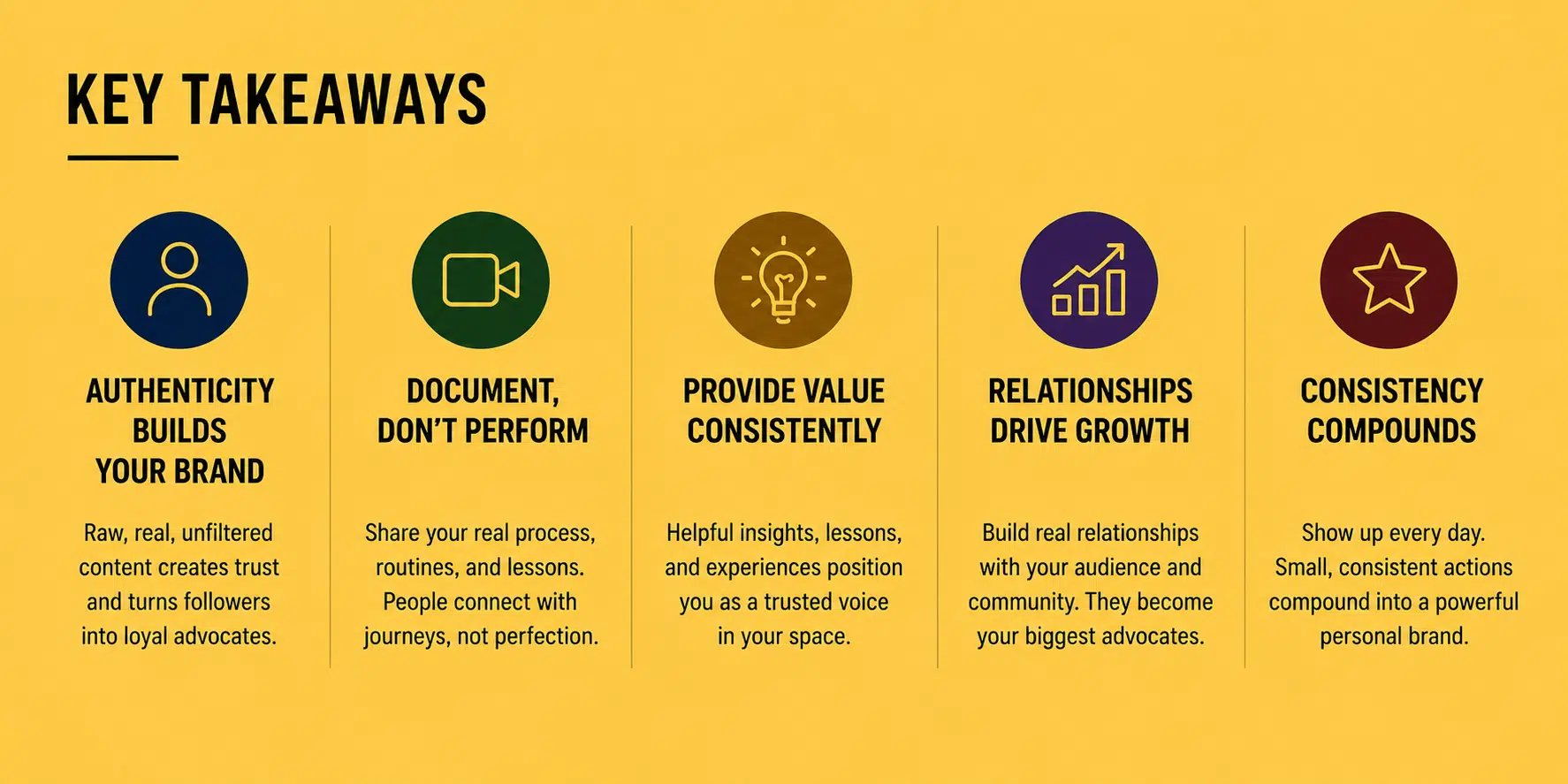
The framework is simpler than most people want to believe: document, don’t perform.
Mark Wahlberg, who turned his personal brand into the foundation of Municipal — a performance lifestyle brand built entirely on the credibility of his documented discipline — is one of the clearest examples of what this looks like in practice. His content is not inspirational marketing. It is a live record of a 3am alarm, a workout that most people would never attempt, and a day that most people would never sustain.
“I’ve got to be super disciplined. That’s why I get up at 3:00 in the morning… I try to get ahead of it every single day.”
Wahlberg’s audience does not follow him because he has something to sell. They follow him because he has something real to show. The product becomes almost incidental to the relationship — which is exactly why it converts.
The key distinction is the difference between creating content about your life and creating content from your life. The former requires effort and resources. The latter just requires the willingness to be seen.
The Luxury Brand TikTok Playbook: Why High-End Sells Raw
The conventional wisdom in luxury marketing has always been exclusivity, production quality, and carefully managed scarcity. That playbook is being rewritten in real time.
Olivia Fernie built a luxury travel business almost exclusively through TikTok — not by making aspirational content that looked like a tourism board campaign, but by making access content: the real conversations, the behind-the-scenes logistics, the decisions that go into curating a $50,000 trip.
Her audience grew because she broke the unspoken rule of luxury marketing, which is that the client should never see the work. She showed the work. And what she found is that showing the work does not diminish the premium — it justifies it.
The insight that transfers to any personal brand building a presence on social media is this: people do not pay a premium for a product they understand. They pay a premium for a product they trust. And trust is built through transparency, not production value.
Authentic Marketing That Actually Works: The Content Creator Model
There is a meaningful difference between authentic personal branding and authentic marketing content, and understanding that difference is what separates the founders who are growing from the ones who are just posting.
Authentic marketing is not the same as being unfiltered. It is being specific. The content that builds real audiences on social media in 2026 is content that could only have come from one specific person in one specific situation. Generic insight, however well-produced, is ignored. Specific experience, however rough around the edges, travels.
Maris Bradley, who built his training and empowerment brand from a single gym in Wichita, Kansas to a national stage partly by documenting his community work, describes his coaching philosophy in a way that translates directly to content strategy:
“You’re going to hate it and you’re going to hate me. But my focus is on you. I want you to love you by the time it’s all said and done.”
That is not a marketing message. It is a conviction. And when that conviction comes through in content — unedited, not dressed up — it is more persuasive than any ad.
The pattern across every founder who has used personal branding to drive meaningful business growth on social media is the same: they stopped trying to be interesting to everyone and started being useful to the exact person they were building for. The algorithm rewards specificity. More importantly, so does trust.
Personal Branding Strategy for Entrepreneurs: The Three Non-Negotiables
Across conversations on The Disruptors, three principles show up consistently among founders who have built their personal brands into genuine business assets.
1. Consistency beats production. Mark Wahlberg’s 3am routine is not valuable because it is visually compelling. It is valuable because it happens every single day. The personal brand that shows up consistently — even imperfectly — will always outperform the brand that shows up occasionally with a polished campaign.
2. Community is the product. David Roditz of VCR Group made this point about their Flyfish Club membership — their blockchain-based members-only restaurant concept that raised $15 million in memberships in one minute — but it applies equally to personal brands:
“These people believed in us. They paid money to be part of this thing, but it’s more than just the money. They believed in something, a vision, a dream. And without them, it would never become a reality.”
The personal brand that builds community does not need to manufacture reach. Its community does that for it.
3. Show, don’t announce. The most effective personal brands on social media do not tell their audience that they are successful, credible, or worth following. They demonstrate it through the specificity of their content. Josh Kapon does not announce that he makes the best burgers in America — he wins the Burger Bash eight times and puts the belt on camera. The result is the same, but the trust is completely different.
What the 1% Actually Does Differently on Social Media
The honest answer to how the most successful founders are building personal brands online is not glamorous: they are simply more willing than everyone else to be seen — specifically, to be seen doing the actual work, making the actual decisions, and living the actual life that their brand is built on.
That willingness requires something that no budget can buy. It requires clarity about who you are and what you stand for, and enough conviction in that to share it publicly without managing how it lands.
The personal branding strategies that work in 2026 are not new. They are the application of an old principle — people trust people they know — to the platforms that now allow anyone to make themselves known at scale.
The one percent is not doing something different. They are doing something consistently, specifically, and without apology.
FAQ
Start with specificity, not scale. The founders who have built the most durable personal brands on social media started by being extremely specific about who they were building for and what problem they understood better than anyone else. Olivia Fernie did not try to reach everyone interested in travel — she created content for people who wanted access to the real thinking behind ultra-high-end trip planning. That specificity is what triggers the algorithm and builds trust simultaneously.
The evidence from founders who have done it consistently points in the same direction: specificity and consistency outperform production quality. This does not mean deliberately low-quality content — it means content that could only have come from you, in your specific situation, with your specific point of view. That is what audiences in 2026 are paying attention to.
Yes, and the model that works is counter-intuitive: show the access, not the aspiration. The luxury audience on TikTok is not looking for a brochure. They are looking for proof that the person behind the brand actually knows what they are talking about. Showing the work — the real decisions, the real logistics, the real expertise — is what builds the trust that converts at premium price points.
Document rather than perform. Show the real decisions and real process behind your business. Build for a specific person rather than a broad audience. Show up consistently rather than occasionally with high production. And invest in community — the personal brand that turns its audience into genuine community members has a growth engine that compounds without advertising spend.
IN THIS ARTICLE
1. Why Polished Content Is Killing Your Brand
2. How to Build a Personal Brand Without a Budget
3. The Luxury Brand TikTok Playbook
4. Authentic Marketing That Actually Works
5. Personal Branding Strategy: The Three Non-Negotiables
6. What the 1% Does Differently on Social Media
7. FAQ
SHARE THIS ARTICLE