
What Top Founders and Doctors Actually Think About Ozempic, Peptides, and Longevity
June 30, 2026 | 7 min read
The next decade of health won’t be won by whoever diets the hardest. It will be won by whoever engineers their body with the same precision they engineer their business.
That is the shift happening right now among the founders, doctors, and operators building the next generation of health and performance companies. While most people are still arguing about Ozempic on social media, the one percent is asking a more specific question: what does the data say about my body, and what is the fastest, most precise way to fix what’s broken?
Across conversations on The Disruptors, one theme keeps resurfacing: weight is not a vanity metric. It is the single biggest lever on how long — and how well — you live. And the people who understand that early are not waiting for willpower. They are using science.
The One Percent Doesn't Diet. They Engineer.
For most of modern history, weight management was treated as a moral test: eat less, move more, try harder. The one percent has quietly abandoned that framework.
Dr. Tom Cahill of New Path, a venture fund that has backed companies behind some of the biggest breakthroughs in GLP-1 medicine and genomics, put it bluntly on The Disruptors:
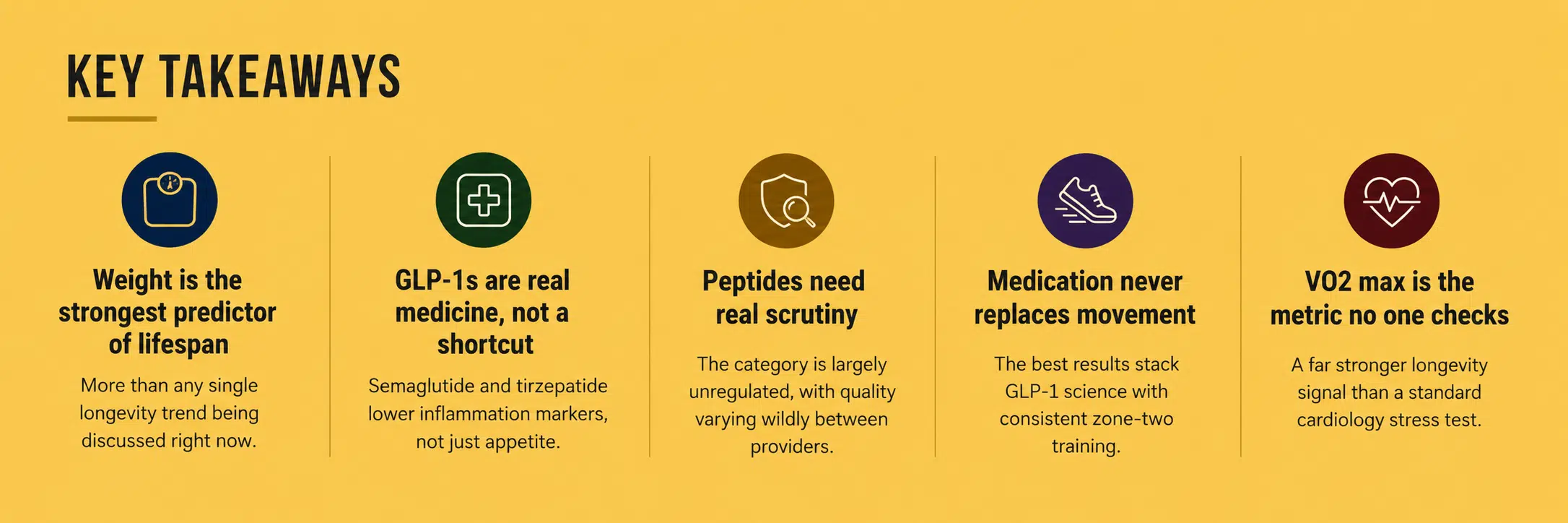
“The biggest correlation and impact on lifespan is not kind of what people are talking about with longevity. It’s weight. Weight correlates to lifespan. It’s why you typically don’t see, you know, people that are older than 80 that are overweight.”
That single idea reframes the whole conversation. Weight isn’t just about how you look in a photo — it’s the clearest predictor of how many healthy years you have left. And once you treat it that way, the question stops being “how do I lose 15 pounds before summer” and starts being “what is the most precise tool available to fix this, permanently.”
GLP-1s, Peptides, and the End of Guesswork
This is where semaglutide (Ozempic), tirzepatide (Mounjaro, Zepbound), and the broader category of GLP-1 drugs enter the picture — and where the one percent’s thinking diverges sharply from the noise online.
Cahill doesn’t frame GLP-1 weight loss as a shortcut. He frames it as the most consequential medical breakthrough most people haven’t fully understood yet:
“It’s been transformative in ways that people don’t think… if you look at people who get on these GLP-1s, their inflammation markers go down. It’s been amazing to see the secondary outcomes of this.”
Dr. Jesse Greer of Preamble, a preventive health practice built around proactive, data-driven medicine rather than reactive sick care, goes even further into the mechanics of what’s actually happening in the body — and points to a category most people haven’t caught up to yet: peptides.
“The GLP-1s are just this like almost like huge game changer to the face of medicine.”
But Greer is careful to separate the science from the noise. Peptide therapy for weight loss is a fast-growing, largely unregulated space, and he doesn’t sugarcoat the risk:
“There’s a lot of crap out there for sure… there was like huge lack of regulation on a lot of it.”
For someone weighing a GLP-1 dosage chart against a peptide protocol, that distinction matters. Semaglutide and tirzepatide are FDA-approved, studied at scale, and dosed with precision. Many peptides marketed for weight loss exist in a gray zone — some genuinely effective, many unproven. The one percent approach isn’t to avoid either category. It’s to demand the same rigor for both.
Why Exercise Still Wins — Even in the GLP-1 Era
None of this replaces movement. If anything, the people most fluent in GLP-1 science are also the most disciplined about training — because the drugs change appetite, not character.
Mark Wahlberg, who has built an entire wellness and gym business around documenting real transformation rather than Instagram before-and-afters, described his own non-negotiable routine on The Disruptors:
“I’ve got to be super disciplined. That’s why I get up at 3:00 in the morning… I try to get ahead of it every single day.”
Maris Bradley, a former NFL prospect who turned personal training into a mission-driven movement, frames discipline the same way — not as punishment, but as identity:
“You’re going to hate it and you’re going to hate me… but if these tips go in to their game and if they use them… that’s awesome to me.”
And this is where Dr. Greer’s clinical perspective connects the dots. The actual metric elite athletes train around isn’t willpower — it’s a number most people have never measured.

The Real Metric No One Talks About: VO2 Max
If there’s one health metric the one percent is quietly obsessing over, it’s VO2 max — the maximum amount of oxygen your body can use during exercise, and arguably the single strongest predictor of longevity available today.
“It is the supreme factor that can kind of tell you how healthy somebody is, right? Longevity-wise… probably the most powerful metric that there is,” Greer explained.
He also broke down why elite athletes spend most of their training time in “zone two” — a moderate, almost boringly slow intensity — rather than going hard every session:
“The guys who run 5-hour marathons and the guys who run 2-hour marathons… practice almost the same amount of time in their high-intensity zones. But if you look at the time that they’re training in those zone two… it is astronomically higher.”
That’s the kind of detail a standard physical never tells you. A treadmill stress test at a cardiologist’s office is built to catch an imminent heart attack — not to tell you whether your aerobic base can support the next 30 years of your life.
How to Think Like the One Percent About Your Health
Thinking like the one percent here doesn’t mean chasing every new injection or biohacking trend. It means applying the same rigor to your body that you’d apply to a business decision.
Start with data, not assumptions. Get your real metrics — weight trends, inflammatory markers, VO2 max — instead of guessing based on how you feel.
Then, separate proven tools from unproven ones. GLP-1 medications like semaglutide and tirzepatide have real, peer-reviewed evidence behind them. Peptide therapy may have a future, but as Greer notes, “be very, very skeptical” of anything without it.
Finally, never treat medication as a replacement for movement. The people getting the best long-term results are stacking GLP-1 science with zone-two training, not substituting one for the other.
The future of health won’t reward whoever tries the hardest. It will reward whoever measures the most accurately — and acts on what the data says.
Not guesswork.
Not willpower alone.
Precision.
FAQ
Based on what the doctors featured on The Disruptors describe, it isn’t an either/or decision. GLP-1 drugs like semaglutide and tirzepatide change appetite and inflammation markers, but long-term health outcomes — especially longevity — are still driven by consistent movement, particularly aerobic “zone two” training.
According to Dr. Jesse Greer, the peptide space is largely unregulated, and quality varies enormously between providers. Some peptides, including GLP-1s themselves, are well-studied and effective. Others marketed online carry real safety and sourcing risks. The recommendation is to apply real scrutiny before starting any peptide protocol.
VO2 max measures the maximum amount of oxygen your body can use during intense exercise. Described as “probably the most powerful metric” for predicting long-term health, it offers far more insight than a standard cardiology stress test, which is mainly designed to catch immediate cardiac risk rather than overall fitness capacity.
IN THIS ARTICLE
1. Primer subtitulo de la seccion
2. FAQ
SHARE THIS ARTICLE