
How the One Percent Thinks About AI, Work, and the Future of Success
June 30, 2026 | 6 min read
The next generation won’t compete with AI. It will compete with people who know how to use AI better.
That is the shift many of today’s founders, investors, creators, and high performers are already making. While most people are asking whether AI will replace jobs, the one percent is asking a different question: how can I use this technology to think faster, build better, and become harder to replace?
Across conversations on The Disruptors, a recurring theme has emerged. The people building companies, leading teams, investing in the future, and navigating disruption are not treating AI as a distant trend. They are treating it as a new layer of leverage.
And that may be one of the clearest differences between average thinking and one percent thinking.
The One Percent Does Not Fear Change. They Study It.
Every major shift creates two groups of people.
One group waits. They hope the world slows down. They ask whether the change is fair, whether it will affect them, whether things will go back to the way they were.
The other group studies the change while it is happening. They look for the new rules. They ask where value is moving. They try to understand what skills will become more important, what work will be automated, and what opportunities will appear before everyone else sees them.
AI is no different.
For many people, the conversation around artificial intelligence starts with fear: Will AI replace my job? Will it make my degree less valuable? Will it make creative work, legal work, finance, marketing, or operations easier to automate?
But the highest performers tend to frame the question differently. They are less interested in whether AI will replace an entire profession and more interested in how it will separate people inside that profession.
As Mateesh Agarwal of Positron AI put it on The Disruptors:
“It’s not like AI is replacing jobs yet, it’s people who are better at AI are replacing the people who are not using AI.”
That sentence captures the real shift.
The future of work may not be a simple story of humans versus machines. It may be a story of AI-enabled people outperforming people who refuse to adapt.
AI Will Not Eliminate Ambition. It Will Expose It.
One percent thinking is rarely about having access to tools no one else has. In many cases, the tools are available to everyone.
The difference is how seriously people use them.
AI can help write, research, summarize, edit, analyze, design, code, plan, and create. But access alone does not create an advantage. The advantage comes from curiosity, speed, judgment, and execution.
Someone can use AI to produce generic work faster. Someone else can use the same tool to ask better questions, test more ideas, understand a market more deeply, and produce a stronger outcome.
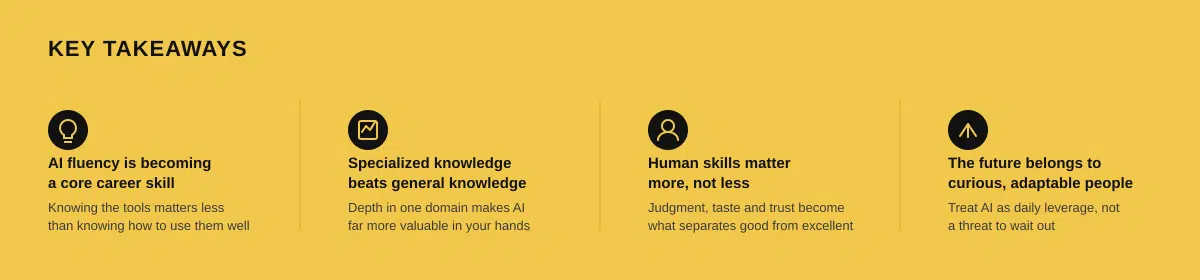
That is why AI literacy is becoming less of a technical skill and more of a career skill.
The people who move ahead will not simply be the ones who know which tools exist. They will be the ones who know how to combine those tools with taste, domain expertise, communication, and problem-solving.
In other words: AI raises the floor, but it may also raise the ceiling.
It makes basic output easier. But it also gives ambitious people more leverage than ever before.
The Future Belongs to People With Specialized Knowledge
There is another pattern that appears again and again among high performers: they do not try to be vaguely good at everything.
They develop depth.
AI can generate surface-level information quickly. It can summarize what is already known. It can produce drafts, outlines, and ideas. But the people who become truly valuable are the ones who understand a specific problem deeply enough to know what matters, what is missing, and what should happen next.
That is why specialized knowledge may become more valuable, not less.
Justin Sherlock of Caspian described this mindset clearly:
“Get specialized knowledge and then find people that support you in chasing down that problem. So you need specific exposure to a very specific problem.”
This is a powerful lesson for students, young professionals, founders, and anyone trying to build a career in a changing market.
The goal is not just to “learn AI.” The goal is to combine AI with a real domain: healthcare, law, finance, logistics, entertainment, defense, climate, education, media, or any other field where complex problems exist.
AI can multiply your ability. But it needs direction.
The more specific the problem you understand, the more valuable the tool becomes in your hands.

Human Skills Are Becoming More Important, Not Less
As AI becomes more capable, human skills become more visible.
Judgment. Taste. Trust. Leadership. Creativity. Emotional intelligence. The ability to ask the right question. The ability to persuade people. The ability to decide what not to do.
These are not disappearing.
In fact, they may become the difference between average output and excellent output.
If anyone can generate a first draft, the value moves to the person who knows whether the draft is good. If anyone can create a video quickly, the value moves to the person who knows what story should be told. If anyone can produce analysis, the value moves to the person who can interpret it and make a decision.
This is why the “AI will replace everyone” narrative is too simple.
AI will change work. It will automate parts of many roles. It will make some tasks cheaper and faster. But it will also increase the value of people who can bring context, direction, originality, and strategic thinking.
The one percent mindset is not to ignore the threat. It is to build the skills that remain valuable when the tools get better.
How to Think Like the One Percent in the AI Era
Thinking like the one percent does not mean trying to predict the future perfectly. It means building habits that make you more adaptable than the market around you.
Start by treating AI as a daily tool, not a novelty. Use it to research, draft, compare, pressure-test, summarize, and explore ideas. The people who build fluency now will have an advantage over people who wait until the tools are unavoidable.
Then, choose a domain where you can go deep. General knowledge is easier to automate. Specific insight is harder to replace. The strongest professionals will be the ones who understand a valuable problem deeply and use AI to move faster against it.
Finally, keep developing the skills AI cannot easily copy: taste, trust, communication, leadership, creativity, and judgment. These are the skills that turn output into value.
The future of work will reward people who can learn quickly, adapt without panic, and use new tools before they become obvious.
That is the real one percent mindset.
Not fear.
Not denial.
Leverage.
FAQ
No. The article makes clear that AI literacy is becoming a career skill, not a technical one. What matters more is curiosity, asking the right questions, and knowing how to combine AI with real domain knowledge — not coding ability or a technical degree.
Start by treating AI as a daily tool rather than a novelty: use it to research, draft, compare, and pressure-test ideas in whatever you’re already working on. The people who build this habit early gain an advantage over those who wait until it becomes unavoidable.
Not the way most people fear. The article argues AI is more likely to replace people who refuse to use it than to replace entire professions. The professionals who combine deep, specific expertise with AI tools become harder to replace, not easier.
IN THIS ARTICLE
1. Primer subtitulo de la seccion
2. FAQ
SHARE THIS ARTICLE